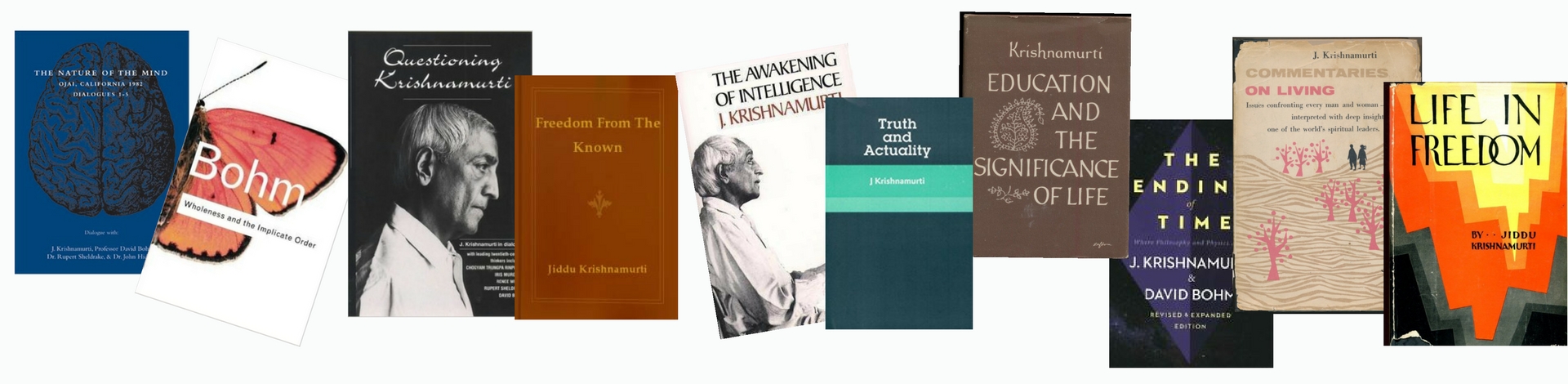
This and the next few messages will be a prelude: So, why did we choose this name for the blog? By my assessment it just sounded right. We both were very taken with K for years and shared in many meaningful online dialogues in various K groups. For me the inquiry was very enlivening, even thrilling, and, I suppose, to create and perpetrate that vital affect could be considered a form of desire. Niko was very grounded, but I was some kind of naive K fanatic for decades and will maybe share my personal story around that. Why did we on some level become disenchanted? Speaking for myself, I began to see he was skipping steps in order to create a psychological/physiological affect. Now is that good to do? Well it could be, but in this case of being the so-called world teacher, maybe not. There is a maze of contextual subtlety, and one can get hooked on trying to sort things out, much like eating peanuts. So what is the antidote for this kind of mental addiction? Would it be to see the beauty of a rose or to have sex? I think not.
In the Middle Way school of Buddhism (according to them, the third time the Buddha turned the wheel, ie,the larger scope) this kind of approach of K would be that of the Hinayana (Theraveda) school of Buddhism, the smaller scope. The way they explain the smaller scope is that the person of this propensity wants to achieve enlightenment only for himself. So what does this even mean? Of course Hinayana Buddhists can be very kind and loving. I know this for a fact, and surely they are not doing this only for themselves. And, er, yet they are, as we all are on some level. Speaking from what I now understand, the intended meaning is that people of this data processing propensity perceive the experiences of sensation to be ultimately true, and this in some way does make sense, as on a simple level it is perceptually true, but if we go further it is easy to see that the functional value of this approach is, from the angle of comprehensive data processing, very limited. I think it is because the process of thinking is in itself substantial, ie, a substance, and the basic way the thinking process works is that one thing often represents and so functions as a bridge to something else. so if people have too many different and often contradictory meanings which they consider to be ultimately true, it is difficult to consciously do things together to help each other.
Actually if you are interested in word construction, thought is an interesting word. Th-ou-g-ht. Without going into much detail, the letters TH (theosophy and Greek theos) are related to the word, god or God, Will not go into H right now. So, at the beginning of the word thought: th and at the end, ht:-) and in the middle, ou and g. I do not know about ou, but just riffing — in this context, an interesting word is plough –pl-ou-g-h. Re what I have just written, would this be using thought as a tool *or* is this a form of eating peanuts? (And, when editing, it just now occurs to me that using thought as a tool could also be a form of eating peanuts.) Technically it could be either depending upon how one uses the so-called tool. There are many different ways to use tools. People even collect. I collect old often rusted tools and make sculptures of therm. Many people interested in both G and K are coming to this blog, to see what K wrote about Gurdjieff, so it is worth noting, from Google, re Gurdjieff’s book: “Beelzebub relates his past experiences in a solar system called Ors (our solar system) where he had been banished for rebelling against His Endlessness. . He spent his exile in observation of the solar system, and of Earth and humans in particular.”
 Deconstructing Krishnamurti
You must be logged in to post a comment.